Yes, there are snakes in Costa Rica, and more of them than almost anywhere else you are likely to holiday. Around 140 species live in the country, of which roughly two dozen are venomous enough to matter medically. The one that matters most is the terciopelo, known in English as the fer-de-lance, which is responsible for most serious bites in Central America. Snakes in Costa Rica are a real feature of the landscape, not a myth, and the country takes them seriously enough to produce its own antivenom.
Should you be worried? Only a little, and only in specific situations. The large majority of bites happen to farm workers and rural residents, not to tourists on resort grounds or guided rainforest walks. Visitor bites are rare, treatment is good by regional standards, and a few simple habits, closed shoes, a torch at night, staying on trails, remove most of the remaining risk. Costa Rica’s hospitals are used to snakebite, and the Instituto Clodomiro Picado near San José supplies antivenom across the country.
This guide names the species that matter, explains where and when encounters happen, gives an honest view of the danger, and sets out exactly what to do if someone is bitten. It also covers the crocodiles, insects and other wildlife that are worth a thought on a Costa Rican trip.
Contents
- Which venomous snakes live in Costa Rica?
- Which non-venomous snakes will you see?
- Where and when do snake encounters happen?
- How dangerous are Costa Rica's snakes really?
- Practical safety tips for avoiding snakebite
- What to do if you are bitten
- Other wildlife worth knowing about in Costa Rica
- Frequently Asked Questions
- Bottom line
Which venomous snakes live in Costa Rica?
Costa Rica’s venomous snakes fall into two families: the pit vipers, which cause nearly all serious bites, and the coral snakes, which are dangerous but reclusive. Add one sea snake on the Pacific coast and you have the full list of species to respect.
| Species | Where it is found | Risk level |
|---|---|---|
| Terciopelo / fer-de-lance (Bothrops asper) | Caribbean and Pacific lowlands, plantations, forest edges, riverbanks | High; causes most serious bites in the country |
| Central American bushmaster (Lachesis stenophrys) and black-headed bushmaster (Lachesis melanocephala) | Deep primary rainforest; the Caribbean slope and the Osa Peninsula respectively | High if bitten, but encounters are very rare |
| Eyelash viper (Bothriechis schlegelii) | Low and mid-elevation forest, often on branches at head height | Moderate; small but common and easily missed |
| Central American rattlesnake (Crotalus simus) | Dry forest of Guanacaste and the north-west | High if bitten; uncommon near tourist areas |
| Hog-nosed and jumping pit vipers (Porthidium, Metlapilcoatlus) | Leaf litter in lowland and foothill forest | Moderate; painful bites, rarely fatal |
| Coral snakes (Micrurus species) | Forest floor nationwide, usually under logs or leaf litter | High neurotoxic venom, but bites are rare and require handling |
| Yellow-bellied sea snake (Hydrophis platurus) | Open Pacific water, occasionally washed onto beaches | Potent venom, but bites almost never happen |
The terciopelo: the snake to know
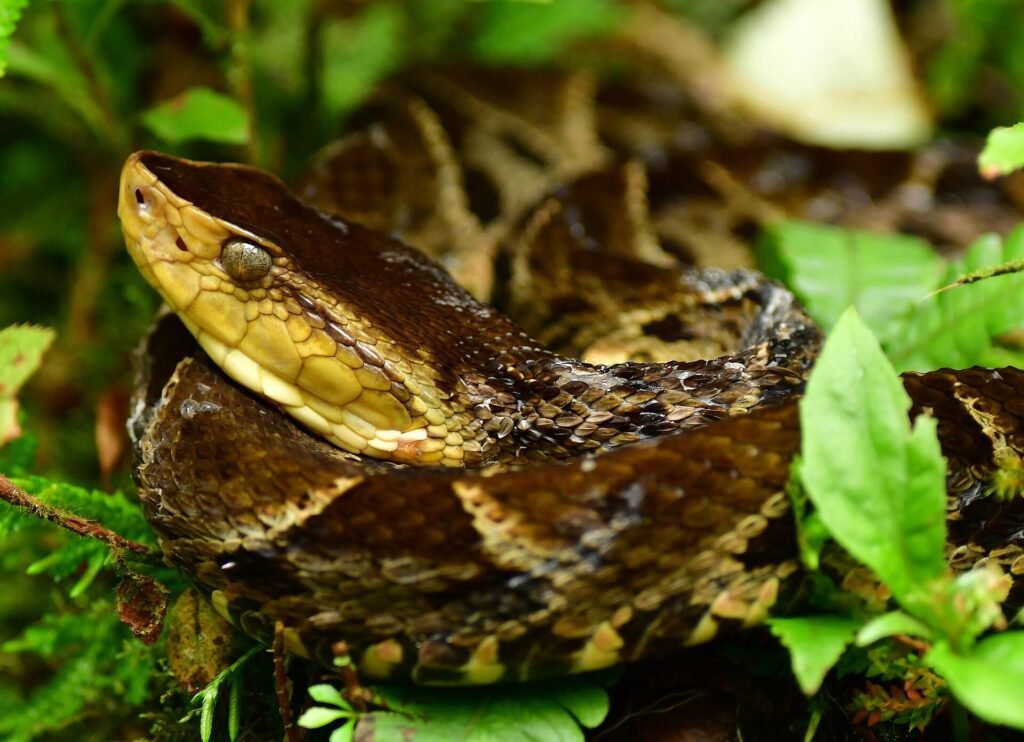
The terciopelo is a large, heavy-bodied pit viper that can exceed two metres, with a brown and cream diamond pattern that disappears into leaf litter. It thrives in disturbed habitats such as banana and palm plantations, pasture edges and the fringes of villages, which is why it meets people so often. It is mainly nocturnal and has a reputation for standing its ground rather than fleeing. Its venom causes severe local swelling and tissue damage and can be fatal without antivenom, so a suspected terciopelo bite is a genuine emergency.
Eyelash vipers: small, pretty and at eye level
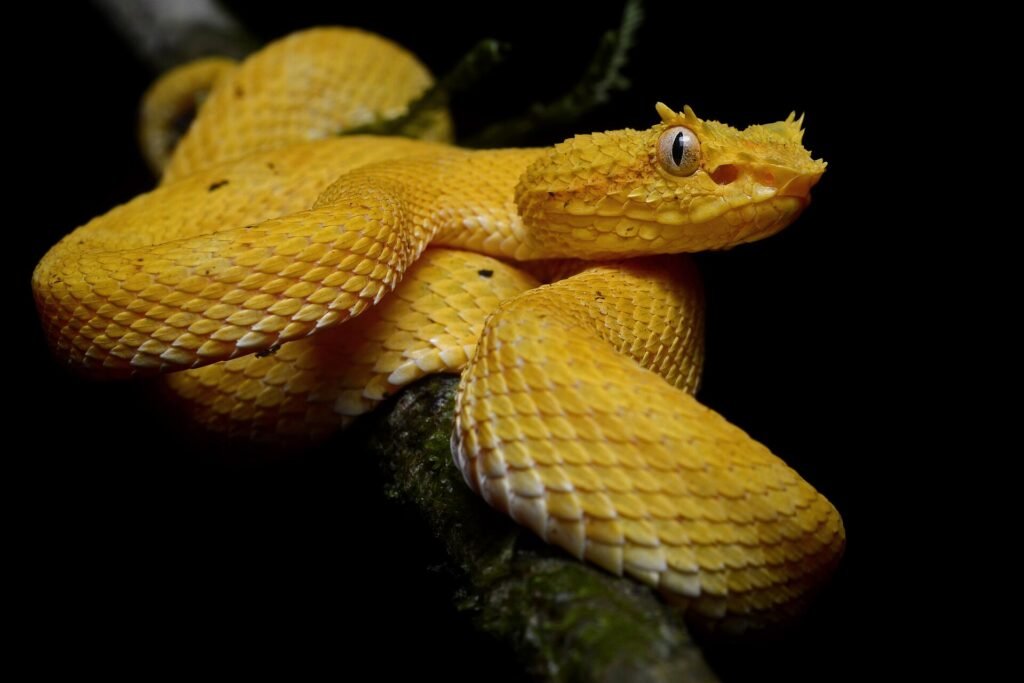
The eyelash viper is the snake most visitors actually photograph. It comes in green, brown and a striking yellow form, and it rests coiled on branches and heliconia leaves at hand and face height. Its bite is rarely fatal but is painful and needs treatment. The practical lesson is to keep your hands off vegetation when you walk a trail and to look before you lean in for a close-up.
Coral snakes
Costa Rica has several coral snake species with the familiar red, yellow and black banding. Their venom is neurotoxic and dangerous, but they are secretive, have small mouths and almost always bite only when picked up. Several harmless mimic species share the colours, and the old rhymes about band order are not reliable in Central America, so treat every banded snake as a coral snake and leave it alone.
Which non-venomous snakes will you see?
Most snakes you encounter will be harmless. Boa constrictors are common in the lowlands and often turn up in hotel gardens and road verges. Slender green vine snakes and parrot snakes hunt lizards in the canopy, the tiger rat snake is a long, fast climber, and a handful of cat-eyed and false coral snakes share the forest floor. None of these poses a danger, though a boa will bite if grabbed. The sensible rule is to assume any snake could be venomous and give all of them space.
Where and when do snake encounters happen?
Snakes are present across the entire country, but encounters cluster in predictable places and at predictable times.
Caribbean lowlands and the Osa Peninsula
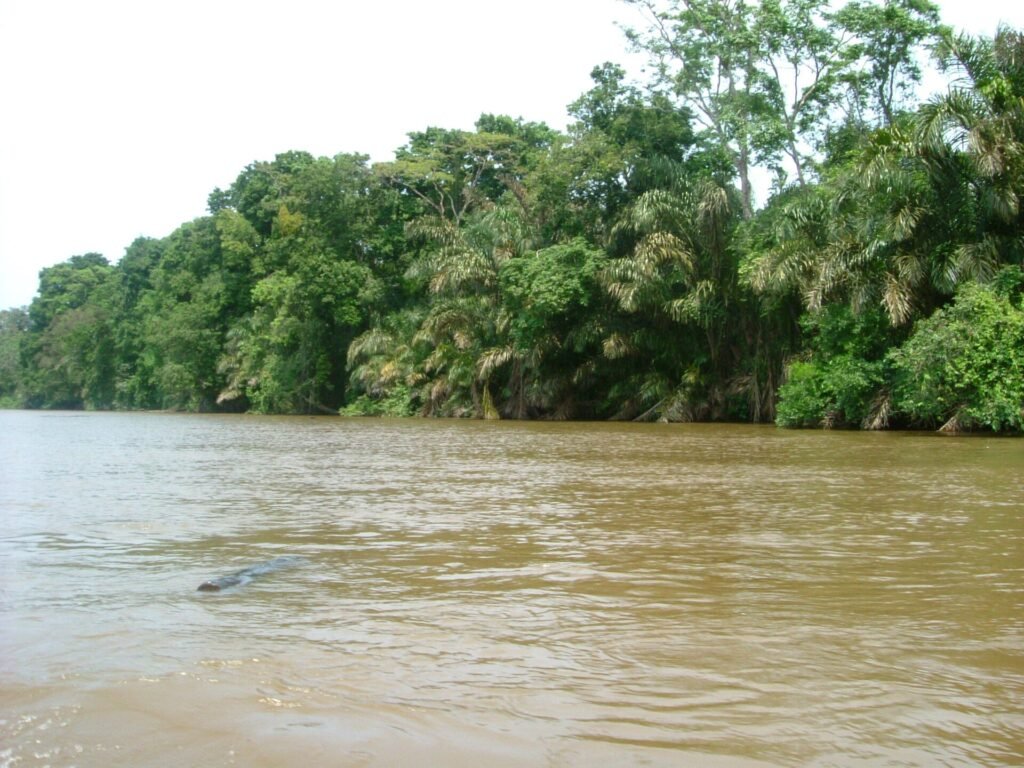
The hot, wet Caribbean side around Tortuguero, Puerto Viejo and Sarapiquí has the richest snake fauna, including the terciopelo and the bushmaster. Corcovado National Park on the Osa Peninsula is the same story on the Pacific side. These are also the places with the best guided hikes, and a good guide will spot an eyelash viper you would have walked past.
Guanacaste’s dry forest
The north-west is drier and has fewer species, but it is rattlesnake country, with sightings peaking in the May to November rainy season.
Resorts, beaches and towns
Landscaped resort grounds in Tamarindo, Manuel Antonio, Jacó or La Fortuna see the occasional boa or small colubrid, and very rarely a terciopelo at the edge of the property. Beaches are not snake habitat, though a yellow-bellied sea snake occasionally washes up on the Pacific sand; do not touch one.
Time of day and season
Most dangerous species are nocturnal, so the hours after dark on unlit paths carry the highest risk. The wet season brings more activity, and bites peak in the agricultural months when workers are in the fields. For a visitor, that translates into one rule: carry a torch and watch your feet from dusk onward.
How dangerous are Costa Rica’s snakes really?
Costa Rica records several hundred snakebites a year by widely reported health ministry figures, most of them to agricultural workers in rural lowlands, and deaths are uncommon thanks to good access to antivenom. Tourist bites are rare, and tourist deaths from snakebite are rarer still. The country’s public hospital system treats snakebite routinely, and antivenom from the Instituto Clodomiro Picado covers all the native pit vipers and coral snakes.
The context matters. Costa Rica has more venomous species than the Caribbean islands, where our guide to snakes in Aruba describes just one, but it also has a medical system built around the problem. Compare that with snakes in Bali, where antivenom coverage is patchier and the same bite can be harder to treat.
Realistically, the things more likely to spoil your Costa Rica trip are rip currents, car accidents on mountain roads, sunburn and a bout of traveller’s stomach. Our full safety advice for travel in Costa Rica covers those in detail.
Practical safety tips for avoiding snakebite
- Wear closed shoes with ankle coverage on trails, and rubber boots if your lodge offers them for wet-forest walks.
- Stay on marked trails and walk with a guide in primary rainforest; guides see snakes you will not.
- Never put your hands on branches, leaves, logs or rock ledges without looking first.
- Carry a torch after dark and use it on every path, including the one from the restaurant to your cabin.
- Do not step over a log; step onto it and look at the far side before stepping down.
- Never handle, prod or pose with a snake, even one that looks dead.
- Know the location of the nearest hospital before you head into a remote area, and save 911 in your phone.
What to do if you are bitten
Treat every bite as venomous until a doctor tells you otherwise. The goal is to reach a hospital with antivenom as fast as possible, not to treat the bite yourself.
- Move away from the snake and sit or lie down. Keep the bitten limb still and below or level with the heart.
- Call 911, Costa Rica’s national emergency number, or get to the nearest public hospital or clinic run by the Caja Costarricense de Seguro Social. Your lodge or guide will know the closest one.
- Remove rings, watches and tight clothing from the limb before it swells.
- Do not cut the wound, suck out venom, apply ice, use a tourniquet or take alcohol or painkillers containing aspirin.
- Note the time and, only if it is safe from a distance, photograph the snake. Do not try to catch it.
- Keep calm and still while travelling. For a coral snake bite, where the venom is neurotoxic, a firm pressure bandage over the limb is reasonable if help is far away.
Private hospitals in San José such as CIMA and Clínica Bíblica also treat snakebite and are familiar with foreign insurance. Travel insurance with medical and evacuation cover is strongly recommended, especially if you are heading to the Osa Peninsula or Tortuguero, where the nearest hospital is a long boat or road journey away.
Other wildlife worth knowing about in Costa Rica
Crocodiles
American crocodiles live in rivers and estuaries on both coasts, famously under the Tárcoles bridge and in the mangroves around Tamarindo and Tortuguero. Never swim in river mouths or estuaries, and heed signs at beaches near them.
Insects and spiders
Bullet ants deliver an extremely painful sting and live on tree trunks in lowland forest; do not lean on trees. Scorpions are common and their stings are painful but rarely serious. Mosquitoes carry dengue, and both coasts see outbreaks, so use repellent and check the CDC or WHO pages for current advice on dengue, Zika and malaria before you go.
Monkeys and raccoons
Capuchin monkeys and raccoons at Manuel Antonio have learned to raid bags, and a bite from either carries a rabies and infection risk, so do not feed them.
Frequently Asked Questions
How common are snakebites for tourists in Costa Rica?
Rare. The large majority of bites in Costa Rica involve rural workers in fields and plantations. Visitors who stay on trails, wear closed shoes and use a torch at night have a very small chance of a bite, and the country’s antivenom supply and hospital experience make a bad outcome unlikely even then.
Are there snakes at Costa Rican beach resorts?
Occasionally. Boas and small harmless species sometimes turn up in resort gardens, and a terciopelo can appear at the edge of properties bordering forest or plantation. Resort staff deal with them routinely. Snakes are not found on the beach itself, apart from the rare sea snake washed ashore on the Pacific.
Can I visit Corcovado or Tortuguero safely with children?
Yes, with a guide. Families visit both every year. Keep children on the trail, in closed shoes, and within arm’s reach on night walks, and teach them not to touch any animal or plant. The main risks for children in those areas are heat, dehydration and water, not snakes.
Which Costa Rican snake is the most dangerous?
The terciopelo, or fer-de-lance, because it combines potent venom with a habit of living close to people. Bushmasters have a larger venom yield but are rarely encountered, and coral snakes almost never bite unless handled.
Bottom line
Snakes in Costa Rica are numerous and some are genuinely dangerous, with the terciopelo at the top of the list. Even so, bites to visitors are rare and the country is better prepared to treat them than almost any of its neighbours. Wear closed shoes, stay on the trail, hire a guide in the rainforest, use a torch after dark and keep your hands off the vegetation. Follow those habits and the snakes become one more reason the wildlife here is extraordinary, rather than a reason to stay away.