Thailand is one of the safest countries in Southeast Asia for foreign teachers, and most of the thousands of English teachers who arrive each year finish their contracts with nothing worse than a sunburn and a few good stories. If you are asking “is Thailand safe for English teachers?”, the honest answer is yes for violent crime, mostly yes for petty crime, and “it depends on you” for the two things that genuinely hurt foreigners most: motorbikes and careless employment arrangements.
The US State Department keeps Thailand at Level 1, “exercise normal precautions”, apart from the far southern provinces, and the UK FCDO advises against all but essential travel only to Pattani, Yala, Narathiwat and parts of Songkhla. Almost nobody teaches there as a first job. Everywhere else, your risk is shaped far more by how you ride a scooter, which school signs your contract and whether you hold health insurance than by where you live.
This guide covers where petty crime happens, why road safety is the number one issue, the health hazards nobody mentions at orientation, and how to check a school or agency is legitimate.
Contents
- Safety at a Glance
- Where Do Teachers Live, and Does It Change the Risk?
- Petty Crime: What Actually Happens to Teachers
- Why Road Safety Is the Real Issue
- Health Risks Teachers Underestimate
- Before You Sign With a School or Agency
- Solo Teachers, Seasons and Local Laws
- Emergency Numbers in Thailand
- Frequently Asked Questions
- The Bottom Line
Safety at a Glance
| Risk area | Level for teachers | Notes |
|---|---|---|
| Violent crime | Low | Rare against foreigners; most incidents involve late-night bar disputes in tourist zones. |
| Petty theft | Low to moderate | Bag snatching and phone theft in crowded nightlife areas of Bangkok, Pattaya and Phuket. |
| Road traffic | High | The biggest cause of serious injury to foreigners. Scooter crashes dominate. |
| Health | Moderate | Dengue, rabies from street dogs, heat, seasonal smoke in the north. |
| Employment and visa issues | Moderate | Unregistered agencies, missing work permits, overstay penalties. Avoidable with checks. |
| Natural hazards | Low to moderate | Monsoon flooding, burning-season smoke, rare tremors felt from neighbouring countries. |
| Political unrest | Low | Occasional Bangkok protests; the Deep South provinces are the exception. |
Where Do Teachers Live, and Does It Change the Risk?
Most first-year teachers land in Bangkok, Chiang Mai, a provincial capital in the northeast or central plains, or a beach town such as Hua Hin, Phuket or Krabi. Each has its own profile.
- Bangkok: Big-city rules apply. Khao San Road, lower Sukhumvit and Patpong see the most reported petty theft. Residential districts where teachers rent, such as On Nut, Bang Na and Lat Phrao, are quiet.
- Chiang Mai: Relaxed and walkable with very low violent crime. The hazards are ring-road scooter traffic and the February to April smoke season.
- Isaan and provincial towns: Often the safest places of all, because everyone knows who you are. The trade-off is less English-speaking medical care and heavier dependence on a motorbike.
- Beach towns: Patong in Phuket and Pattaya’s Walking Street concentrate bar incidents, drink-driving and theft. Live a few kilometres away and the experience changes completely.
If you are comparing Thailand with other teaching destinations in the region, our guides to the cheapest places to live in Vietnam and the overlooked dangers in Singapore are useful counterpoints.
Petty Crime: What Actually Happens to Teachers
Petty crime in Thailand is opportunistic rather than confrontational. The incidents that recur in teacher forums and embassy advisories are predictable: a phone lifted in a night market, a bag snatched by a passing motorbike passenger, or a rental shop claiming “damage” to a scooter and demanding a large payment.
A few habits remove most of the risk. Carry bags on the side away from the road, keep your phone off cafe tables, photograph a rental scooter from every angle before riding away, and never hand over your passport as a deposit. A photocopy is accepted for everyday ID; the original stays in your apartment safe. Drink spiking is reported occasionally in Bangkok and Pattaya, so watch your drink being poured.
Why Road Safety Is the Real Issue
Thailand consistently ranks among the countries with the highest road traffic death rates in the WHO’s Global Status Report on Road Safety, and motorcycles account for the large majority of those deaths. Most teachers live somewhere a scooter is the default way to reach school, and most arrive having never ridden one.
- Get licensed properly. An international driving permit must carry a motorcycle endorsement from your home licence to be valid on a scooter. Without it you are riding illegally, and most insurers will refuse a claim after a crash.
- Wear a real helmet, not the plastic shell the rental shop hands you. A full-face helmet from a reputable brand costs a fraction of a hospital bill.
- Do not ride at night in the rain or after drinking. Unlit roads, potholes, street dogs and wrong-way drivers are all more common after dark.
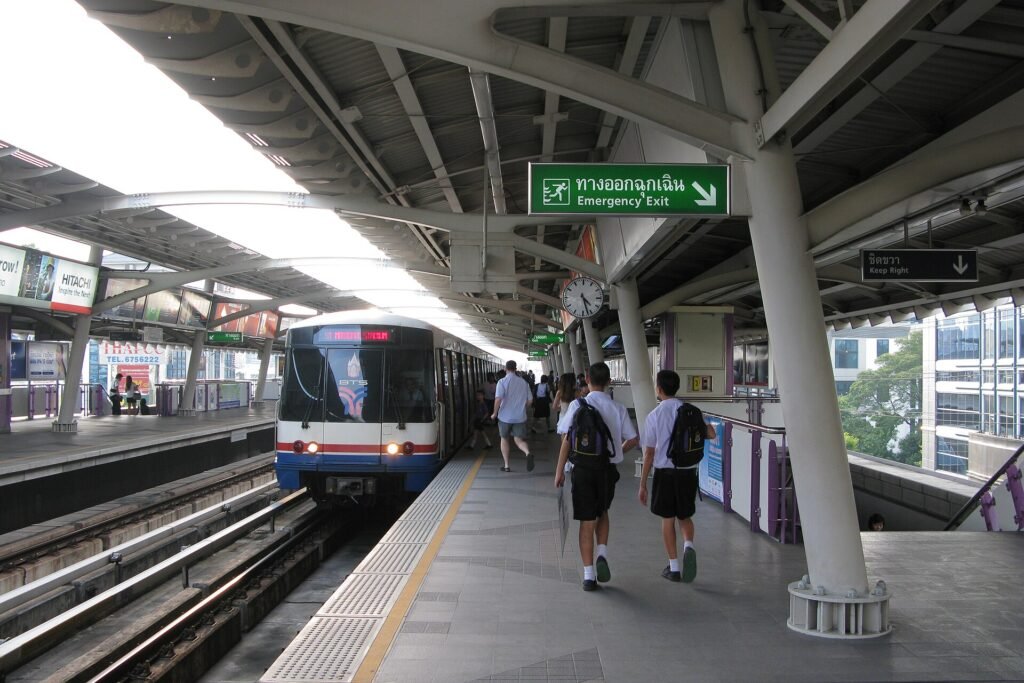
Public transport is a safe alternative where it exists. Bangkok’s BTS Skytrain and MRT are clean and reliable, and the Grab and Bolt apps work in every major city. For long distances, the state railway or a daytime bus is calmer than an overnight coach.
Health Risks Teachers Underestimate
Dengue and rabies
Dengue is present year-round and peaks in the rainy season from roughly June to October. Repellent with DEET or picaridin, window screens and emptying standing water near your apartment are the only real protection. Soi dogs are part of every Thai town and rabies is present in the dog population; the CDC recommends pre-exposure vaccination for long stays. If bitten or scratched, wash the wound for fifteen minutes and get to a hospital the same day. Check the CDC and WHO pages for Thailand for current vaccine guidance.
Heat, water and smoke
April is the hottest month, and new arrivals routinely underestimate it. Tap water is not for drinking anywhere in Thailand; refill stations are cheap. In the north, agricultural burning from February to April pushes PM2.5 to levels where an N95 mask and an air purifier are sensible purchases, and anyone with asthma should plan around it.
Hospitals and insurance
Private hospitals in Bangkok, Chiang Mai and Phuket are excellent and used to foreign patients; government hospitals are competent and far cheaper but busier. Teachers on a legitimate work permit are normally enrolled in the Thai Social Security Fund, which assigns you a hospital for subsidised care, but many agencies skip this step, so ask directly. Most experienced teachers also hold private health insurance with inpatient cover and medical evacuation. This article is general information, not financial or legal advice.
Before You Sign With a School or Agency
The most common bad outcome for a new teacher is not a crime at all. It is arriving on a tourist visa for a job that never materialises, or working for months without a work permit because the agency “is sorting it out”. Working without a permit exposes you, not the agency, to fines, detention and a re-entry ban.
Red flags to watch for:
- You are told to enter on a tourist visa and “convert later” with no timeline and no named person responsible for your Non-Immigrant B visa and work permit.
- The agency wants to hold your original passport or degree certificate.
- You are asked to pay a placement fee or “visa deposit” before you have a signed contract.
- The advertised salary is far above the typical range for that school type. As of 2026, agency and government school placements commonly pay in the mid tens of thousands of baht a month, private and bilingual schools pay more, and international schools pay several times that.
- Nobody can tell you which school you will be placed at.
How to verify an offer:
- Ask for the school’s full Thai name and phone number, then call the school directly rather than the agency.
- Get written confirmation that the employer will apply for your work permit and the provisional teaching permit or waiver from the Teachers’ Council of Thailand (Khurusapha), which the school submits, not you.
- Search teacher forums for the agency name and read the newest comments.
- Get the contract in English and Thai with salary, hours, holiday pay and start date in writing, and keep copies of everything.
Solo Teachers, Seasons and Local Laws
Solo and female teachers
Thailand is popular with solo female teachers, and most describe it as one of the easier countries in the region to live alone. Street harassment is rare and colleagues are usually protective. Use ride-hailing apps late at night and choose a condo with 24-hour reception or keycard access. Dress as your Thai colleagues do at school; covered shoulders and knees earn respect quickly.
Seasons and natural hazards
The rainy season runs from roughly May to October in most of the country, later on the Gulf coast. Flooding in Bangkok and the central plains is routine and rarely dangerous, but it can shut roads and schools for days. Earthquakes are rare inside Thailand, but strong quakes in Myanmar can be felt in Bangkok, as in March 2025 when high-rises swayed. If you live on a high floor, learn the evacuation route, and on the Andaman coast note the signed tsunami evacuation routes.
Laws that catch teachers out
- Lèse-majesté: Any negative comment about the monarchy, including online, is a serious offence.
- E-cigarettes: Importing, selling and possessing vapes is illegal, and fines are widely reported.
- Cannabis: Rules have changed repeatedly since 2022 and were tightened again in 2025. Check current regulations and never carry any product across a border.
- Overstaying and working on the wrong visa: Fines accrue daily and long overstays bring a re-entry ban. Diarise your visa expiry and 90-day report, and only teach once your permit is issued.
Emergency Numbers in Thailand
Save these before you land: 191 for police, 1669 for medical emergencies and ambulance, 1155 for the English-speaking Tourist Police, and 199 for fire. Register with your embassy’s traveller programme, such as the US State Department’s STEP or Australia’s Smartraveller, so they can reach you during flooding or unrest. Our guide to staying safe when travelling abroad covers document backups, money and insurance in more depth.
Frequently Asked Questions
Is Bangkok safe for English teachers to live in?
Yes. Bangkok is a large, modern city with low violent crime and excellent transport. Petty theft is concentrated in nightlife zones, and the residential districts where most teachers rent are quiet. The main hazards are traffic and dry-season air quality.
Should I avoid teaching in southern Thailand?
Avoid Pattani, Yala, Narathiwat and the southern districts of Songkhla, where the US State Department and UK FCDO advise against most travel because of a long-running insurgency. The rest of the south, including Phuket, Krabi, Hat Yai city and Surat Thani, is not covered by those warnings and hosts plenty of teachers.
Do I need health insurance if my school enrols me in Social Security?
Social Security gives you subsidised care at one assigned hospital, which is a good safety net. It will not cover medical evacuation, a private hospital of your choice or care in another country, so most teachers also hold private cover. Check whether your school actually registers you.
Is it safe to ride a scooter in Thailand?
It is the riskiest thing most teachers do. Crashes are the leading cause of serious injury to foreigners in the country. Ride only with a proper licence, a real helmet, insurance that covers motorcycles, and never after drinking.
What is the safest time of year to arrive?
The cool season from November to February is the most comfortable, with lower dengue risk and no flooding. Most school semesters begin in May and November, so a late-October arrival gives you time to settle before the second semester starts.
The Bottom Line
Thailand is a safe place to teach English, and the risks that remain are ones you can control. Treat road safety as seriously as a Thai hospital bill, get vaccinated and insured before you arrive, verify any school or agency before you sign, and respect the handful of laws that carry heavy penalties. Do that, and the country’s hospitality, low cost of living and easy travel connections make it one of the most rewarding places in Asia to start a teaching career.